Computer Science Fundamentals
What Are Data Structures? A Beginner-Friendly Guide
Arrays, stacks, linked lists — what the words actually mean, why each one exists, and how to tell which to reach for.
If you're new to coding, you've probably come across terms like array, stack, or linked list and thought, "what does that even mean?" You're not alone. These are all data structures, and they are simply different ways of arranging information so a program can work with it efficiently.
This guide breaks down what they are, why they matter, and introduces the handful you will actually use — in plain language, with the trade-off for each one spelled out.
What is a data structure?
Think of organising a wardrobe. Shirts in one drawer, socks in a box, coats on hangers. Nothing is stored more efficiently in the abstract, but finding a specific sock becomes far quicker because the arrangement matches how you search.
Data works the same way, and the difference shows up as you scale:
Everything in one pile
Storing all your data in a single unstructured list. Finding one item means checking every item — fine for ten things, painful for ten thousand.
A drawer per category
Choosing a structure that matches the shape of the data. You go straight to the right drawer instead of searching the whole room.
Labelled and indexed
Adding a hash map or an index on top. Now you find any item in roughly one step, no matter how much you own.
Why they matter
Four reasons this is worth your time early rather than late:
- Efficiency: the right structure makes programs faster and less memory-hungry.
- Scalability: what works for 100 records should still work for 100,000.
- Problem solving: most coding problems are really a question of picking the right structure.
- Real-world use: from social feeds to navigation systems, they are everywhere.
The practical version: a badly chosen structure does not just run slower, it makes some features impractical to build at all.
The six you will actually use
Each of these exists because it makes one operation cheap. The note under each card is the job it is genuinely good at.
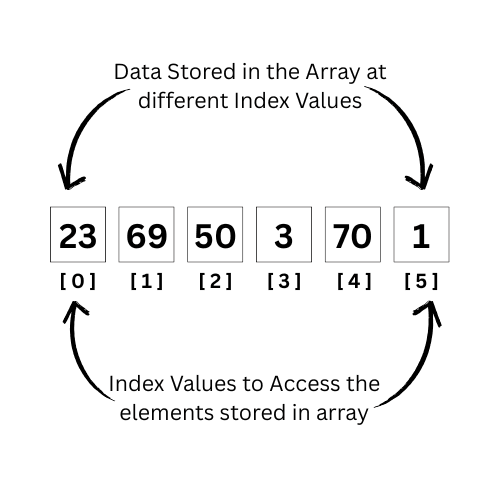
Array
A row of boxes, each holding a value at a numbered position. Reading position 4 is instant, but inserting in the middle means shifting everything after it.
Best for ordered items you mostly read
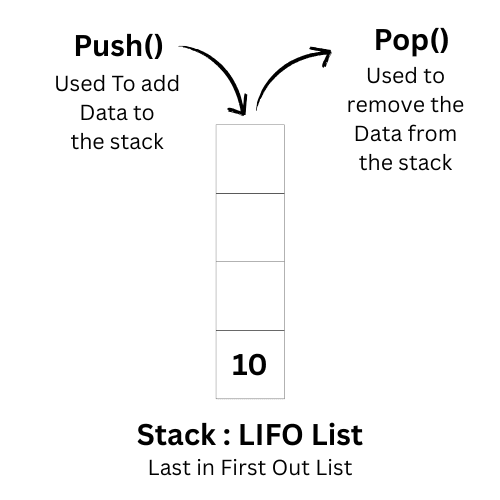
Stack (LIFO)
A stack of plates — you add and remove from the top only. The last thing in is the first thing out.
Best for undo history and backtracking
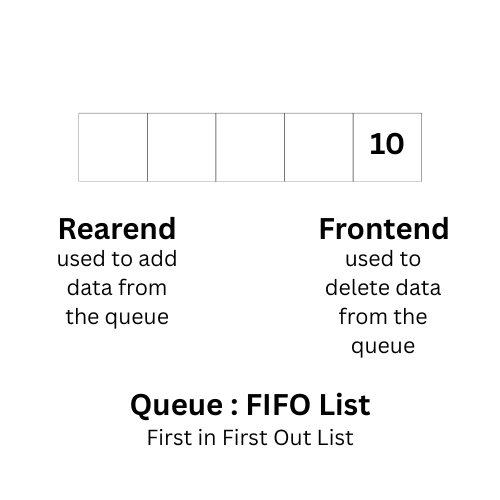
Queue (FIFO)
People standing in line. The first to arrive is the first served, and nobody jumps ahead.
Best for scheduling and task processing
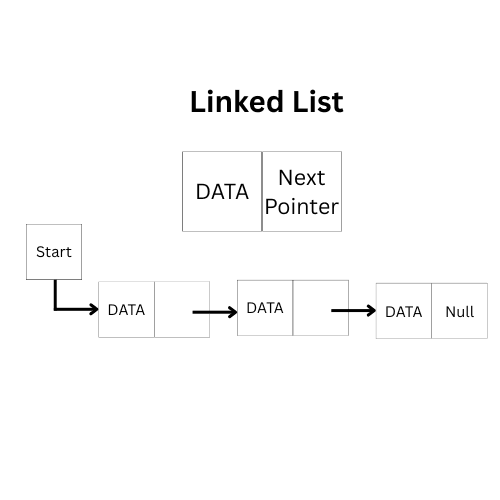
Linked List
A chain of nodes, each holding a value and the address of the next. There is no fixed size, and inserting means rewriting one link.
Best for frequent insertions and removals
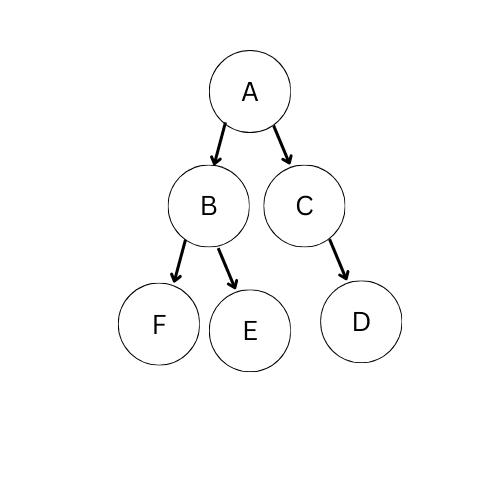
Tree
Starts at a root and branches out. Each step down usually halves what is left to search, which is where the speed comes from.
Best for hierarchies and fast lookup
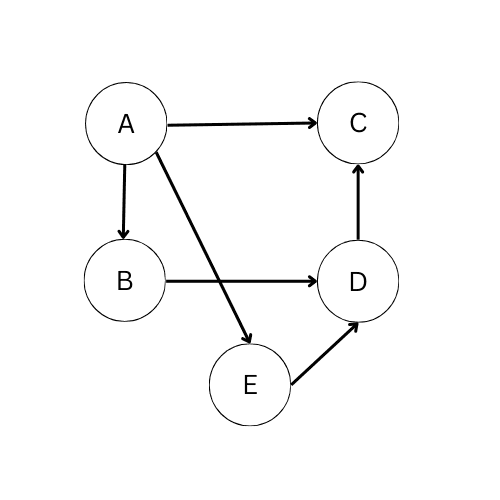
Graph
Nodes connected by edges, with no required shape. Any node can link to any other, which is how real networks behave.
Best for networks, maps and recommendations
Seeing it in one small app
Suppose you build a contact list. Watch how each new requirement pulls in a different structure:
- Store the names in an array so they keep their order.
- Add a hash table so searching by name is instant rather than a scan.
- Sort the array to display contacts alphabetically.
- Notice that each requirement pushed you toward a different structure — that is the whole skill.
Common questions
- Do I need to memorise every data structure?
- No. Six carry most of the weight: arrays, hash maps, stacks, queues, trees and graphs. Learn those properly and the rest are variations you can pick up when you meet them.
- What is the difference between a data structure and an algorithm?
- A data structure is how the data is arranged; an algorithm is what you do with it. Sorting is an algorithm, the array it sorts is the structure. Choosing the structure usually decides which algorithms are even available to you.
- Does the language change any of this?
- The concepts are identical everywhere. Only the names and the built-ins change — a Python dict, a Java HashMap and a JavaScript Map are the same idea with different labels.
Final thoughts
Data structures are the toolbox every programmer carries. You do not need all of them on day one — start with arrays and hash maps, add stacks and queues when a problem calls for order, then move on to trees and graphs.
Practise each one by building something small with it rather than reading about it. What felt like intimidating jargon becomes ordinary vocabulary surprisingly quickly.